Luxembourg 2026: The Ultimate Tax Optimisation Guide for Private Rental Income
In a Luxembourg wealth landscape shaped by mature capital markets and a far-reaching overhaul of property incentives, holding residential real estate as part of one's private assets remains a cornerstone of wealth transfer. However, given the growing requirements of Circular L.I.R. No. 106/2 and the entry into force in February 2026 of the new 10% depreciation regime, an investment's performance now depends on the precision of its tax structuring. This guide explores the optimisation levers available for the 2026 tax year.
1. The Structure of Rental Income: Core Principles and Timing Pitfalls
For any resident or non-resident taxpayer in the Grand Duchy, when a built property held as a private asset (whether a condominium apartment or a single-family house) is let, all incoming cash flows must be classified under the category of net income from the letting of property. These items are reported in detail on the special forms of the Luxembourg Inland Revenue (Administration des contributions directes, ACD), namely form 190 or form 210.
From a purely accounting and tax standpoint, net rental income is the strict excess of gross receipts over the legally allowable expenses incurred to earn that income (frais d'obtention). However, the timing of these receipts follows precise mechanisms that every wealth manager must master.
The two-week economic rule
As a basic principle, rental receipts are allocated to the tax year in which they are actually placed at the taxpayer's legal and financial disposal. However, the legislator has introduced an important exception for recurring payments, first and foremost the monthly rent.
When recurring receipts are paid shortly before the start or shortly after the end of the calendar year to which they relate economically (the administrative tolerance being customarily set at plus or minus two weeks), they must be allocated to the year concerned. For example, January 2027 rent received on 23 December 2026 must be included in 2027 income, keeping the taxpayer's marginal tax brackets consistent from one year to the next.
Focus on related flows: advances, deposits and vacancies
Expenses with no receipts: The owner earns rental income even when, in the absence of current receipts, they incur expenses directly aimed at generating future receipts. For example, renovation costs incurred between one tenant's departure and the next tenant's arrival remain fully deductible.
Advances on charges: Where there is no subsequent statement or precise settlement of charges between owner and tenant, the provisions or advances on charges paid by the occupant legally constitute additional gross receipts to be added to the base rent.
Rental deposit: The deposit paid as security against possible future damage is never treated as a receipt when it is first collected. However, if all or part of the deposit is lawfully retained by the owner at the end of the lease to cover damage, it immediately becomes taxable rental income.
2. The Partial Exemption for Social Rental Management (GLS)
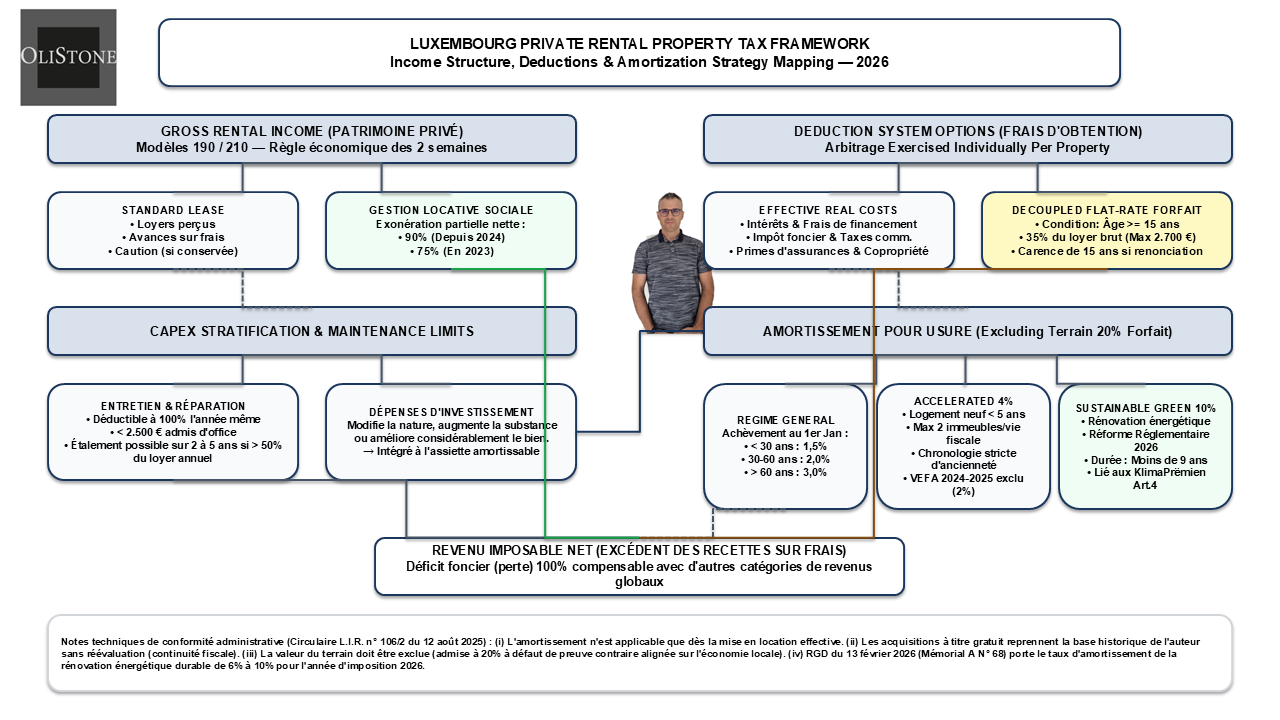
Given the pressures on Luxembourg's residential market, Social Rental Management (Gestion Locative Sociale, GLS) schemes offer an exceptional optimisation framework for investors seeking both hassle-free management and a drastic reduction in their taxable base. Governed by Article 49 of the amended Law of 7 August 2023 on affordable housing, GLS allows owners to entrust their property to an approved organisation (the full list is kept up to date by the Ministry of Housing).
The tax incentive attached to this scheme has risen particularly sharply, reaching its peak for the current tax year:
- Since the 2024 tax year: The exempt portion now amounts to 90% of net rental income. An investor pays progressive income tax on only the remaining 10%.
- For the 2023 tax year: The exemption rate was set at 75%.
- For the 2017 to 2022 tax years: The allowance was limited to 50%.
This 90% exemption applies to the net rental income. The guiding details of this mechanism are set out in Circular L.I.R. No. 115/10 of 18 August 2023. Note that if, after deducting expenses and before the exemption, the property generates a loss (rental deficit), this loss can be offset horizontally and without limit against the taxpayer's other categories of income (salaries, pensions, dividends) for the same tax year.
3. Choosing a Deduction Method: Actual Expenses versus Flat-Rate Deduction
Luxembourg's regulatory framework offers taxpayers a major structural option: declare their expenses at actual cost, or forgo this level of detail by opting for a flat-rate regime. This choice is all the more powerful because it is made individually, property by property, where several built properties are held as private assets.
The standard regime: actual expenses
All expenses incurred directly to acquire, secure and preserve rental receipts are deductible without any cap, provided they are not passed on to or borne by the tenant. The statutory list includes in particular:
- Debit interest directly related to the loan taken out to acquire, extend or build the property, together with ancillary financing costs (arrangement fees, application fees and the costs of the notarial mortgage deed).
- Life annuity payments constituted as consideration for acquiring the property.
- Delegated management fees, property management agency fees, and the wages of caretakers or concierges.
- Property taxes, first and foremost Luxembourg land tax (impôt foncier).
- Non-recoverable municipal charges and taxes (sewerage, drainage, waste collection).
- Compulsory and optional insurance premiums (owner's liability, fire insurance, tenant risks and water damage).
- Mandatory contributions to the co-ownership works fund or any similar reserve fund.
The 35% flat-rate deduction: conditions and limits
Provided for by the amended Grand-Ducal Regulation of 23 October 1980 (implementing Article 107 L.I.R.), the flat-rate deduction removes the need to keep track of supporting documents. However, this regime is strictly regulated:
- The property must form part of the taxpayer's private assets and its construction must have been completed at least 15 full years before 1 January of the tax year concerned.
- The deduction is set at 35% of annual gross rent, with an absolute ceiling of €2,700 per year per property.
A closer look shows that the 35% flat rate does not cover everything. Certain specific expenses remain deductible in addition to the flat rate: debit interest and borrowing costs, management fees, land tax and municipal charges. On the other hand, the flat rate fully absorbs depreciation and maintenance costs.
The waiting period clause: If an owner decides to give up the flat rate and return to actual expenses (for example, to deduct major renovation works), this choice can be reversed. However, a new election for the flat-rate regime will only be possible after a 15-year waiting period following the year of the switch. The choice therefore requires careful multi-year modelling.
4. Treatment of Capex: Ordinary Maintenance versus Capital Expenditure
The tax authorities' requalification of renovation works is one of the main sources of tax reassessments in Luxembourg. Directorial Circular L.I.R. No. 105/8 – 98/1 sets out the criteria distinguishing directly deductible maintenance expenses (Erhaltungsaufwand) from capital expenditure (Herstellungsaufwand).
| Assessment Criterion | Maintenance Expenses (Erhaltungsaufwand) | Capital Expenditure (Herstellungsaufwand) |
|---|---|---|
| Purpose of the works | Maintain or restore the building to good condition and ensure normal use following natural wear and tear. | Change the nature of the property, increase its substance or substantially improve its condition. |
| Tax impact | 100% immediately deductible in the current tax year. | Mandatory capitalisation. The building's cost base increases and the expense is deducted through depreciation. |
| Simplification rule | Applies without any cap if the technical criteria are met. | €2,500 threshold incl. VAT: Automatically accepted as maintenance if the total amount is below this threshold. |
To qualify as capital expenditure, the works must result in a fundamental change in the nature of the building (converting commercial space into residential use), a material increase in its substance (adding a storey, a side extension), or an improvement that goes far beyond the property's original standard. If none of these three criteria is met, the expense is classified as maintenance.
In addition, where works are carried out on a building that was originally dilapidated and completely unusable, the tax authorities consider that reusing existing structures for a reconstruction amounts to creating a new building: the full cost is then added to the depreciable cost base.
Spreading mechanism: To prevent a major maintenance expense from generating a disproportionate rental deficit in a single year, the Grand-Ducal Regulation of 31 July 1980 offers a smoothing option. If significant maintenance expenses relate to more than one year and their individual amount exceeds half of the annual rent received, the taxpayer may request to spread them in equal instalments over a period of 2 to 5 years.
5. The Basis for Depreciation
Depreciation is the key driver of real estate tax optimisation. It allows a notional decline in the building's value to be deducted each year. How the depreciable base is determined depends on how the property was acquired, pursuant to the amended Grand-Ducal Regulation of 19 November 1999.
One cardinal principle governs this area: land is never depreciable, as its economic life is considered unlimited. The land value must therefore always be excluded from the depreciation base.
Rules for calculating the base
- Acquisitions for consideration after 31 December 1940: The base is the overall purchase price or cost, plus all ancillary acquisition costs (registration duties, transcription fees, notary fees, intermediary commissions, non-recoverable VAT and subsequent investments), less the portion relating to the land.
- Acquisitions free of charge (inheritances and gifts): Luxembourg applies the principle of tax continuity. The depreciation base is calculated as if no transfer of ownership had taken place. The historical purchase price paid by the deceased or donor at the last acquisition for consideration is used, less the value of the land at that date. Importantly, inheritance duties paid are never included in the depreciable base and are not deductible expenses.
- Acquisitions before 1 January 1941: The base is set at a flat three times the unit value determined on 1 January 1941.
The 20% flat-rate land valuation
Where the notarial deed of sale does not explicitly split the price between land and buildings, an economic estimate must be carried out. As a simplification, the tax authorities accept a flat 20% share attributed to the land, leaving 80% for the depreciable building. However, Circular L.I.R. No. 106/2 of 12 August 2025 firmly points out that this 20% tolerance cannot apply if it clearly contradicts the economic reality of the local market (for example, in the most urban parts of Luxembourg City, where the value of bare land can represent a much larger share of the total price).
6. The Transitional Regime and Applicable Depreciation Rates
Luxembourg's depreciation rates fall into two groups: the general regime based on the building's age, and incentive regimes designed to support construction or the green transition.
The general scale for normal wear and tear
| Building Age at 1 January | Normal Wear and Tear | Justified Heavy Wear and Tear |
|---|---|---|
| Less than 30 years | 1.5% | 2.0% |
| 30 to 60 years inclusive | 2.0% | 2.5% |
| More than 60 years | 3.0% | 4.0% |
The 2026 regulatory shift: a 10% rate for sustainable energy renovation
Through the Grand-Ducal Regulation of 13 February 2026 (amending the Regulation of 19 November 1999 and published in Mémorial A No. 68 of 18 February 2026), the legislator has significantly increased the accelerated depreciation rate from 6% to 10%.
This exceptional 10% rate applies specifically to capital expenditure incurred for the sustainable energy renovation of a building used for residential letting. To qualify, the renovation works must have been completed less than 9 years before 1 January of the tax year.
Strict conditions and the link with KlimaPrëmien
The law defines sustainable energy renovation exclusively as energy-efficiency measures on a rental dwelling for which State financial aid under Article 4 of the amended Law of 23 December 2016 (the KlimaPrëmien State subsidy scheme for sustainability and the rational use of energy) has been formally granted by the competent authority. Obtaining the subsidy approval is the sine qua non for applying the 10% rate in the tax return.
4% accelerated depreciation on very recent rental housing
To encourage investment in new rental housing, the legislator is keeping the 4% rate for buildings completed less than 5 years before 1 January of the tax year. However, this scheme comes with strict safeguards to prevent excessive concentration of assets:
- The two-property cap: The 4% rate is limited to a maximum of two buildings or parts of buildings per taxpayer, over their entire period of tax liability in Luxembourg (whether resident or non-resident).
- Chronological priority rule: Properties are ranked according to a strict timeline. The first property taken into account is the one with the earliest completion date from 1 January 2023 onwards. The second eligible property is the one whose completion date comes immediately after. Once this two-property quota has been used, the right to the 4% rate lapses permanently for any future property, even if its completion date falls chronologically between the first two.
- Major renovation: The 4% rate is extended by equivalence to capital expenditure incurred when renovating an older dwelling, provided that the total cost of the works exceeds 20% of the building's original purchase price.
The historical exclusion windows for off-plan purchases (VEFA) (2024 - 2025)
Particular attention must be paid to off-plan purchases (Vente en l'État Futur d'Achèvement, VEFA) made in recent years, due to the exclusion clauses introduced in the legislation:
Buildings used for residential letting acquired by the taxpayer between 1 January 2024 and 30 June 2025 under an off-plan (VEFA) deed of sale are excluded from the 4% rate. For these properties, the applicable rate remains 2%.
This exclusion was extended to acquisitions signed between 1 July 2025 and 30 September 2025, provided the preliminary contract (the sale agreement referred to in Article 1601-13 of the Civil Code) had been registered with the AED by 30 June 2025 at the latest. These windows require the deeds to be checked to confirm the depreciation rate applicable in 2026.
7. Practical Case Study and Tax Modelling
To illustrate the complexity and power of these overlapping rules, let us look at Mr Van Der Berg, a Luxembourg resident who holds a portfolio of three rental apartments as private assets for the 2026 tax year.
Analysis and calculation of depreciation charges for the 2026 tax year:
- Property 1: On 1 January 2026, the building was completed more than 5 years earlier (completion in 2021). It therefore falls out of the accelerated depreciation regime. Its rate switches to the general normal wear and tear scale for properties under 30 years old, i.e. 1.5%.Property 1 charge = €300,000 × 1.5% = €4,500
- Property 2: On 1 January 2026, this 2023 apartment is less than 5 years old. It is Mr Van Der Berg's first property in chronological order after 2023. The accelerated 4% rate applies automatically.Property 2 charge = €500,000 × 4% = €20,000
- Property 3: The main (older) building follows the standard scale for its age bracket. However, the comprehensive energy renovation works completed at the end of 2025 and approved under KlimaPrëmien fall directly within the new February 2026 reform. They qualify for the 10% depreciation rate for the 2026 tax year.Property 3 charge (on works) = €100,000 × 10% = €10,000
Overall Result: For this tax year, total deductible depreciation amounts to €34,500. This amount directly reduces overall gross rental income, demonstrating the value of combining the chronological management of new properties with sustainable energy renovation projects.
Plan Your Wealth Tax Strategy
Every private real estate portfolio requires tailored modelling to maximise your after-tax net returns and secure your depreciation.
Book a Strategic ConsultationConclusion: The Need for a Tailored Approach
Optimising private rental income in Luxembourg in 2026 leaves no room for approximation. Between the 90% exemption opportunity offered by Social Rental Management, the subtleties of 4% accelerated depreciation limited to two properties, and the new 10% lever rewarding eco-friendly investment, every decision must be backed by figures. The experts at OliStone are available to review your real estate portfolio and structure your future property acquisitions in the Grand Duchy.