
Deferred Capital Contributions: Luxembourg’s 2026 Corporate Law Revolution
For decades, the standard ritual of incorporating a private limited liability company (Société à Responsabilité Limitée or SARL) in Luxembourg began with a mandatory hurdle: opening a bank account in formation, depositing the minimum share capital of €12,000, and obtaining a formal blocking certificate (certificat de blocage). Only then could a notary seal the company’s birth. On April 28, 2026, the Luxembourg Parliament shattered this bureaucratic bottleneck.
By passing a major amendment to the historic Law of 10 August 1915 on commercial companies (published in Mémorial A n° 266), Luxembourg introduced an optional deferred capital contribution regime for both standard SARLs and simplified SARLs (SARL-S). This reform fundamentally shifts the corporate landscape, accelerating time-to-market for international investors and modernizing the Grand Duchy’s entrepreneurial ecosystem.
1. The Core Mechanism: Subscription vs. Liberation
To fully grasp the scope of this new law, a clear line must be drawn between two distinct corporate concepts that govern how share capital is handled at the birth of a legal entity:
- Subscription (Mandatory at Day One): The total share capital (minimum €12,000) must still be fully committed by the shareholders during the incorporation deed before the notary. Shareholders must legally pledge to own the entirety of the corporate shares.
- Liberation / Payment (Deferred up to 12 Months): The effective cash transfer into the company’s bank account can now be legally postponed. Shareholders have a maximum window of 12 months from the date of incorporation to fully pay up their shares.
The Immediate Practical Benefit
The requirement to provide a bank blocking certificate prior to incorporation is eliminated under this optional regime. Founders no longer have to wait weeks for complex AML/KYC bank onboarding processes just to get their corporate vehicle registered, operational, and active.
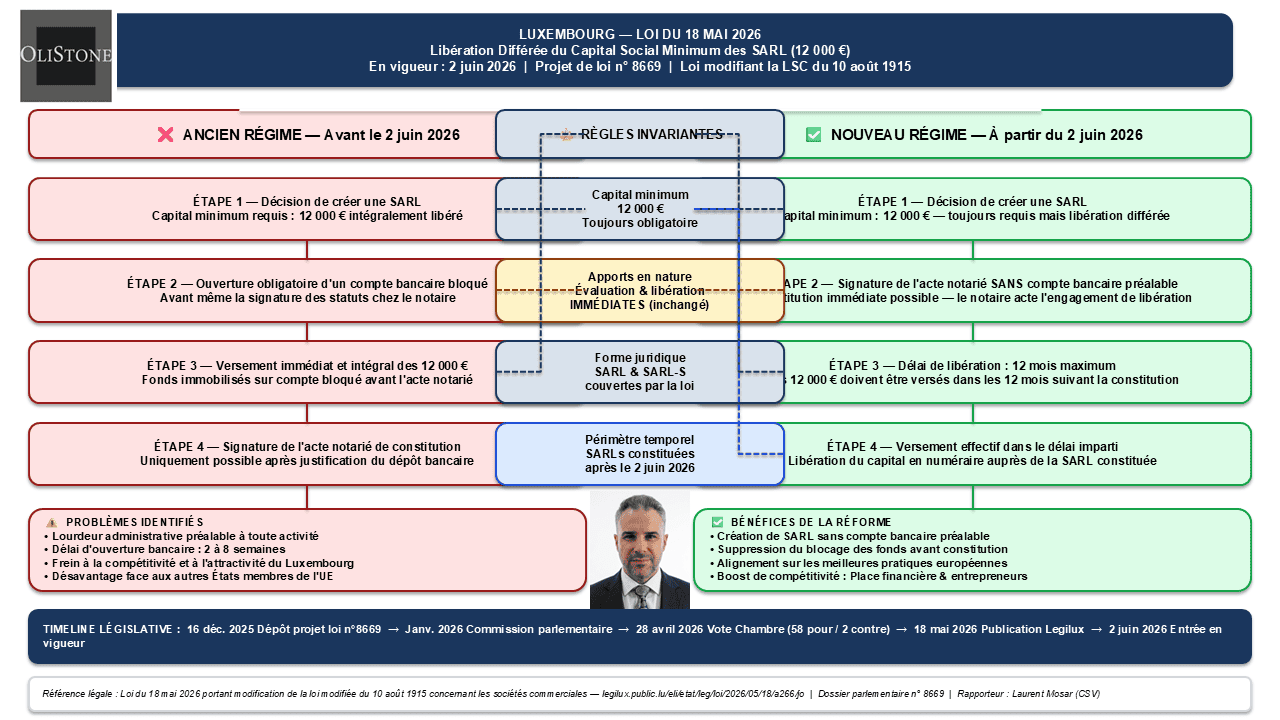
2. Strict Legal Boundaries and Exclusions
To safeguard macroeconomic stability and protect third-party creditors, the legislature implemented strict guardrails. This new corporate flexibility is highly structured and subject to the following rules:
| Regulated Component | Legal Status & Rule under the 2026 Law |
|---|---|
| Type of Contribution | Cash Contributions Only (numéraire). Contributions in kind (property, IP, or shares) must be fully valued and liberated immediately upon incorporation. |
| Cap on Deferral | Limited to the €12,000 minimum. Any share capital subscribed *beyond* the statutory minimum must be paid immediately at the notary’s desk. |
| Share Premiums | Excluded from deferral. If the structure includes a share premium (prime d'émission) at inception, it must be fully paid up on day one. |
| Applicability Window | Limited to Inception. Subsequent capital increases during the life of the company do not benefit from this split and remain bound by immediate liberation rules. |
3. Governance: The Role of Articles of Association and Managers
This deferred regime is not automatic—it is entirely optional. To activate it, the regime must be explicitly organized and tailored within the company’s Articles of Association (statutes).
The law grants exclusive competence to the Board of Managers (gérance) to formally call for the funds at any point during the 12-month window. This requires flawless drafting of corporate bylaws to explicitly outline the exact funding schedule, the legal methods of notification to shareholders, and the specific corporate sanctions in the event of shareholder default.
4. Creditor Protection and Safeguards
To prevent the abuse of "shell companies" and mitigate risks for corporate creditors, the 2026 law introduces rigid transparency and accountability measures:
- Suspension of Voting Rights: If a shareholder fails to respond to a formal call for funds issued by the managers, the voting rights attached to their un-liberated shares are automatically suspended.
- Public Financial Disclosure: The status of the capital will not be a private matter. Companies utilizing this regime must explicitly publish a list of shareholders who have not yet fully paid up their capital—including the exact outstanding amounts—in the annexes of their Annual Financial Statements.
- Founder Liability: The liability regime for founders regarding un-liberated capital has been aligned with the stricter standards governing Public Limited Companies (Sociétés Anonymes or SA).
- Share Transfer Restrictions: Should an associate decide to transfer partially-paid shares during the 12-month window, the transfer documentation must meticulously detail the allocation of the debt between the buyer and seller, preventing any tax or legal grey areas.
Conclusion: A Strategic Leap Forward
The April 2026 corporate law reform marks a profound shift toward pragmatism. By decoupling the legal existence of a company from its initial banking setup, Luxembourg enhances its competitiveness as a leading European business hub.
However, flexibility demands precision. Navigating the interaction between deferred liabilities, corporate governance, and subsequent financial accounting requires careful corporate engineering. OliStone is ready to assist you in auditing your corporate structuring needs, updating your bylaws, and implementing this new regime to optimize your time-to-market in the Grand Duchy.
Plan Your Luxembourg Corporate Strategy
Optimize your time-to-market and schedule a session directly with our corporate advisory desk below.