
The Evolution of Luxembourg’s Alternative Investment Landscape: Deconstructing the SCSp-RAIF Model for US Sponsors
The global private equity, venture capital, and private credit landscapes have undergone a profound structural shift over the past decade. Historically, North American asset managers looking to raise capital globally—particularly across the European Union, the Middle East, and parts of Asia—faced a stark, highly restrictive operational dilemma. They could either attempt to market their domestic US Delaware Limited Partnerships (LPs) or Cayman Islands vehicles via individual national private placement regimes (NPPRs), facing fragmented, costly, and unpredictable regulatory barriers across different European jurisdictions, or they could establish a highly regulated, rigid European onshore corporate vehicle. The latter option frequently clashed with the agile commercial mechanics, flexible capital account structures, and rapid distribution waterfalls that North American sponsors take for granted as foundational components of private market asset management.
The strategic introduction of the Société en Commandite Spéciale (SCSp)—the Luxembourg special limited partnership—via the modernization of the Luxembourg Company Law of 10 August 1915, combined with the structural flexibility of the Reserved Alternative Investment Fund (RAIF) regime under the Law of 23 July 2016, fundamentally altered this competitive dynamic. It provided global sponsors with an onshore vehicle that looks, feels, and operates like a Delaware or Cayman partnership agreement, while simultaneously granting a fully compliant, regulatory-backed marketing passport to distribute fund interests seamlessly across the entire European Economic Area (EEA) under the Alternative Investment Fund Managers Directive (AIFMD).
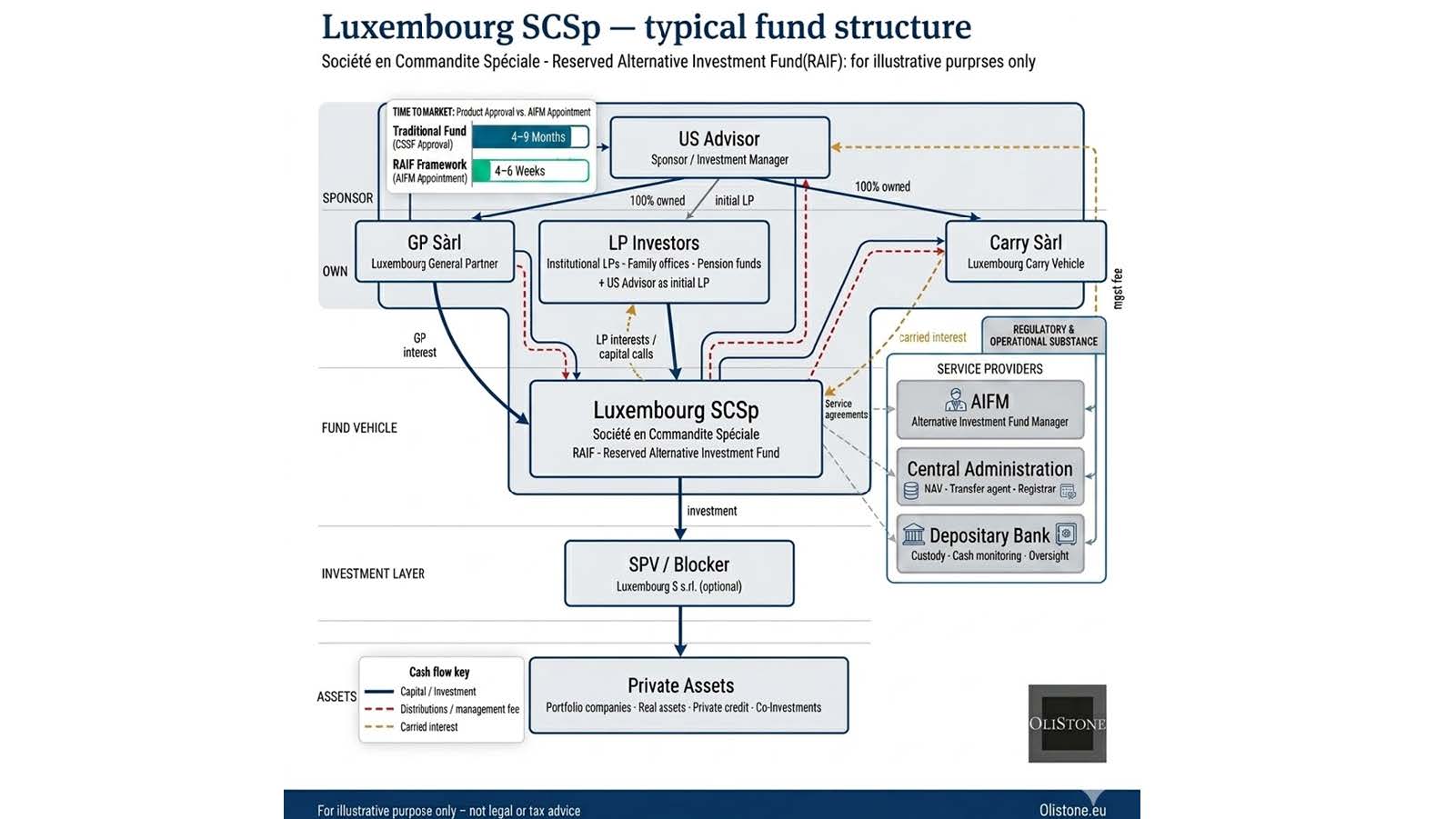
This comprehensive, deconstructed analysis examines an institutional-grade Luxembourg SCSp fund structure specifically configured for a US Investment Manager or Sponsor. By analyzing every layer—from governance architectures and limited partner onboarding to intermediate special purpose vehicle (SPV) optimization, regulated service provider ecosystems, and cross-border fiscal flows—we will map out exactly why this blueprint has crystallized as the default mechanism for transatlantic alternative investment execution.
1. The Core Fund Vehicle: Understanding the SCSp-RAIF Mechanics
At the bedrock of this architecture sits the Luxembourg SCSp, tailored via the regulatory provisions of the RAIF framework. To appreciate the market domination of this vehicle, one must analyze its legal construction independently from its regulatory classification, evaluating how both work together to protect investor confidentiality and preserve total contractual flexibility.
The Legal Framework of the SCSp
The SCSp was deliberately designed to mirror the structural advantages of the Anglo-Saxon limited partnership model. Unlike a traditional European partnership or corporate entity, the SCSp explicitly lacks corporate legal personality. This legal decoupling means that while the SCSp can hold real property, execute binding contracts, pledge assets, and bring legal actions or be sued in its own name, its existence is legally distinct from the corporate identity of its partners. This yields several operational advantages:
- Unparalleled Contractual Freedom: The constitutional governing text of the fund, the Limited Partnership Agreement (LPA), enjoys near-absolute primacy. Luxembourg corporate law explicitly permits sponsors to customize governance provisions, capital call mechanics, equalizations, excused investor clauses, default partner remedies, side-letter implementations, and distribution waterfalls with virtually zero statutory interference.
- Ultimate Investor Confidentiality: Uniquely mapped against standard opaque configurations, there is no requirement under Luxembourg law to publish the identities, ownership percentages, or capital commitments of the Limited Partners (LPs) in the public Luxembourg Trade and Companies Register (RCS). This safeguards institutional-grade privacy and insulates investors from public scrutiny.
- Capital Account Flexibility: Contributions do not constitute formal corporate share capital. They are tracked via tracking accounts, facilitating simple capital drawdowns, variable loan notes, returns of capital, and clawback executions without requiring formal capital reduction notarizations or corporate filings.
The Regulatory Overlay: Why a RAIF?
By superimposing the RAIF (Reserved Alternative Investment Fund) regime over the SCSp partnership structure, the sponsor optimizes the timeline between vehicle formation and initial close. Prior to 2016, establishing a regulated fund in Luxembourg required direct product authorization and continuous oversight from the financial regulator, the CSSF. This often resulted in long regulatory backlogs that stalled time-to-market.
The RAIF framework inverted this regulatory relationship by shifting direct compliance onto the regulated service providers rather than the fund vehicle itself. Under the RAIF Law of 23 July 2016, the fund is exempt from direct CSSF approval, provided it appoints an external, fully authorized Alternative Investment Fund Manager (AIFM).
This structural paradigm yields immediate operational benefits:
- Compressed Launch Timelines: A RAIF can be formed, notarized, registered, and launched within a matter of weeks, enabling sponsors to capitalize on volatile market windows, distressed asset sales, or rapid co-investment opportunities.
- Compartmentalized Architecture (Umbrella Funds): A RAIF can be established with multiple sub-funds or compartments. Each compartment represents a separate pool of assets and liabilities, allowing a US sponsor to run distinct strategies under a single legal entity umbrella.
- Automatic AIFMD Qualification: By choosing the RAIF framework, the vehicle is structurally designated as an Alternative Investment Fund (AIF) under European law, ensuring institutional allocators that the fund complies with global standards regarding leverage limitations, valuation policies, and investor disclosure requirements.
2. Governance & Ownership: The Sponsor and GP Layer
The upper quadrant of the master structural blueprint outlines the governance and control architecture, keeping commercial control within the United States while establishing a compliant, substance-backed management presence in Luxembourg.
The US Advisor (Sponsor / Investment Manager)
The US Advisor serves as the commercial driver of the structure. Typically structured as a Delaware LLC and registered with the US Securities and Exchange Commission (SEC) under the Investment Advisers Act of 1940, this entity retains control over portfolio construction, asset sourcing, underwriting, macro hedging, and investor relations. Because European rules prohibit unregulated third-country firms from directly marketing or managing EU funds without an authorized intermediary, the US Advisor delegates or interacts with the fund through a formal contract: the Portfolio Management Delegation Agreement, executed with the appointed Luxembourg AIFM.
Management of the SCSp is legally vested in the General Partner, typically structured as a Luxembourg limited liability company, or GP Sàrl. Because the SCSp lacks corporate legal personality, the GP Sàrl acts as its legal representative, assuming unlimited liability for the fund’s obligations—a risk that is practically ring-fenced by the limited liability nature of the S.à r.l. structure itself. The US Advisor maintains 100% equity ownership, ensuring no dilution of voting control.
To align team incentives and optimize cross-border tax efficiencies, the structure separates the operating General Partner from the performance fee incentive architecture via a dedicated Carry Sàrl. This vehicle holds the carried interest rights within the SCSp LPA framework. Controlled by the US Advisor, it collects performance allocations directly from the fund waterfall, isolating volatile incentives from regular operating costs.
Substance and Local Governance
To ensure the fund structure is respected by international tax authorities and European regulators, the GP Sàrl must establish verifiable operational substance within Luxembourg. This requires appointing a local Board of Managers comprising experienced, qualified individuals who independently examine decisions, conduct regular physical board meetings in the Grand Duchy, and maintain meticulous corporate record-keeping locally. This substance layer protects against "mind and management" challenges from foreign tax administrations.
3. The Investor Layer: Structuring the LP Base
The investor pool enters the partnership through the LP Investors segment, designed to handle institutional capital allocations, private wealth aggregation, and strategic seeding initiatives simultaneously.
Investor Onboarding & Typology Restrictions
The RAIF law restricts access to the fund to Well-Informed Investors (investisseurs avertis). This legal standard encompasses three primary groups:
- Institutional Investors: Sovereign wealth funds, public and private pension boards, endowment foundations, and insurance conglomerates.
- Professional Investors: Large corporate entities, authorized financial institutions, and regulated family office units.
- Qualified Individuals: Any investor who states in writing that they adhere to the status of a well-informed investor, and either commits a minimum of €125,000 to the vehicle or secures a formal eligibility assessment from an EU-regulated investment firm, bank, or management company verifying their expertise in alternative asset risk profiles.
4. The Investment Layer: Asset Routing and SPV Design
Capital deployed by the SCSp travels down into the target asset classes. While direct asset holding is legally permissible, institutional fund managers routinely integrate intermediate special purpose vehicles (SPVs) into the architecture to maximize legal and financial efficiency.
The Role of the SPV / Blocker (Luxembourg S.à r.l.)
The master design includes an intermediate SPV / Blocker structured as a Luxembourg S.à r.l. This entity provides several core functional layers for international deal routing:
1. Structural Insulation of Liabilities: By routing portfolio allocations through an intermediate S.à r.l., any operational liabilities, asset-level litigation, debt defaults, or environmental hazards originating at the project or portfolio company level are legally contained within that specific SPV. This structure prevents claims from ascending to the SCSp fund level or exposing the broader investor base to direct risk.
2. Double Tax Treaty (DTT) Access: Because the SCSp is viewed as a fiscally transparent partnership by many tax jurisdictions, it can sometimes face challenges when trying to directly claim tax relief under bilateral double tax treaties, depending on the asset's location. A Luxembourg S.à r.l., however, is a fully opaque corporate taxpayer subject to local Corporate Income Tax (CIT). This allows it to access Luxembourg’s global network of over 80 Double Tax Treaties, helping to minimize withholding taxes on incoming interest, dividend distributions, and cross-border capital gains from the target assets.
3. US Tax Blocker Functionality: For US tax-exempt entities, such as pension boards or university endowments, direct investment into asset classes that utilize debt-financing can generate Unrelated Business Taxable Income (UBTI). Inserting an opaque corporate entity like the S.à r.l. can act as an effective tax blocker, converting potentially problematic income streams into clean, predictable dividend distributions, which simplifies US tax reporting for those investors.
5. The Service Provider Ecosystem: Meeting Regulatory and Substance Requirements
Because a RAIF bypasses direct CSSF authorization, its compliance framework depends on a reliable network of regulated local gatekeepers. These entities ensure the fund maintains high standards of compliance, transparency, and operational oversight.
The Alternative Investment Fund Manager (AIFM)
Appointing a fully authorized external AIFM is a mandatory condition under the RAIF Law. US sponsors generally choose between two operational models: establishing their own dedicated, fully staffed, and regulated AIFM in Luxembourg or partnering with an authorized third-party Management Company (ManCo) platform. The AIFM assumes ultimate regulatory responsibility for two primary pillars:
- Portfolio Management: The AIFM is legally responsible for investment decisions. However, it can formalize a delegation framework that passes day-to-day portfolio management responsibilities back to the US Advisor, provided the AIFM maintains continuous oversight, sets clear risk parameters, and retains ultimate veto power over investments to ensure compliance with the fund's mandate.
- Risk Management: The AIFM independently monitors market exposure, leverage levels, counterparty risks, and liquidity profiles, and handles the electronic submission of Annex IV data reports directly to the CSSF. Crucially, appointing an authorized EU AIFM unlocks the AIFMD Marketing Passport across all 27 EU member states.
Depositary Bank and Central Administration
Under the AIFMD framework, every RAIF must appoint a single, independent, Luxembourg-based Depositary Bank alongside a Central Administration Agent. Their respective duties form a tight operational matrix:
- Safekeeping of Assets: Financial instruments that can be held in custody are placed in dedicated accounts. For non-custodiable private equity or private credit assets, the depositary performs regular audits of legal documents, titles, and loan agreements to verify and record the fund’s ownership status.
- Cash Flow Monitoring: The depositary monitors all cash flows across the fund's accounts daily. It ensures that investor subscription payments are properly received and that no cash disbursements are made without verified, compliant supporting documentation.
- Net Asset Value (NAV) Calculation: Independently valuing the fund’s underlying investments, reconciling bank balances, tracking fund expenses, and calculating the precise NAV per interest in strict compliance with Lux GAAP or IFRS standards and the fund's written valuation policies.
6. Cash Flow Dynamics & Financial Architecture
To evaluate the commercial viability of this structure, one must track how capital moves through the system across three primary streams: Capital/Investment, Distributions/Management Fees, and Carried Interest.
Capital / Investment Flows (The Inflow)
When the US Advisor identifies a portfolio investment, a capital call notice is generated and sent to investors. The LP Investors remit their capital commitments directly from their institutional bank accounts to the fund’s cash accounts, which are monitored by the Depositary Bank. Once the compliance checks are complete, the SCSp routes the aggregate capital down through the SPV / Blocker (S.à r.l.), which uses those funds to acquire the target Private Assets.
The Carried Interest Waterfall (The Performance Incentive)
The path of performance-based incentives travels along specialized operational lines. Once the fund has returned all drawn capital to investors, along with a contractually agreed preferred return (the hurdle rate), the distribution waterfall triggers the "carry phase". At this stage, the outperformance cash flows out of the SCSp directly to the Carry Sàrl, rather than the standard investor distribution route. The Carry Sàrl collects these profits and distributes them to the individual partners, portfolio managers, and analysts within the US Advisor's firm, isolating these sensitive performance-driven distributions from the fund's standard operating expenses.
7. Comparative Analysis: Luxembourg SCSp vs. US Delaware LP
For a US Sponsor accustomed to utilizing Delaware Limited Partnerships, adopting a Luxembourg structure requires understanding how key features translate across jurisdictions:
| Structural Feature | US Delaware LP | Luxembourg SCSp (RAIF) |
|---|---|---|
| Legal Personality | No corporate legal personality. | No corporate legal personality. |
| LPA Primacy | High contractual freedom; governance dictated by partnership agreement. | Equivalent contractual freedom; statutory recognition of Anglo-Saxon mechanics. |
| Regulatory Pre-Approval | Generally exempt from prior regulatory product authorization. | No CSSF pre-approval required; indirect regulation via external AIFM. |
| Marketing Capability | Limited across Europe via fragmented country-specific NPPR channels. | Seamless AIFMD Passporting across all 27 EU Member States. |
| Mandatory Service Providers | Typically requires an auditor and administrator; no mandatory depositary. | Strict statutory mandate for an authorized AIFM, Depositary Bank, and Central Admin. |
| Tax Status | Tax-transparent partnership for US federal income tax purposes. | Tax-transparent entity for corporate tax purposes; can check-the-box for US tax. |
8. Strategic Tax Considerations for Transatlantic Funds
Operating a cross-border investment vehicle requires careful planning to maintain tax neutrality and avoid double taxation. From a Luxembourg tax perspective, the SCSp is completely transparent. The fund itself is not subject to local Corporate Income Tax (CIT) or Municipal Business Tax (MBT), nor is it subject to Net Wealth Tax (NWT). Profits are deemed realized directly by the underlying investors based on their pro-rata share in the partnership.
Permanent Establishment (PE) Exposure: A primary tax structuring goal is ensuring that the Luxembourg fund and its underlying SPVs are not deemed to have a Permanent Establishment in the United States, which would inadvertently pull non-US profits into the US tax net. Concurrently, the US Advisor must not inadvertently create a permanent establishment in Luxembourg.
The Impact of ATAD and BEPS
Luxembourg has fully integrated the European Union’s Anti-Tax Avoidance Directives (ATAD I and ATAD II), which target hybrid mismatches and interest deductibility limitations. Furthermore, structures must demonstrate genuine commercial purpose under the OECD’s BEPS (Base Erosion and Profit Shifting) Action Plans. This is why the service provider layer and the GP Sàrl must feature robust local substance, qualified board members, and real operational infrastructure to verify that the entity is not a mere shell.
Conclusion: The Ultimate Cross-Border Capital Bridge
The Luxembourg SCSp-RAIF fund structure illustrated in this blueprint represents a highly functional hybrid of international financial engineering. It preserves the flexibility, confidentiality, and commercial familiarity of the traditional Delaware LP model that US sponsors rely on, while integrating the institutional substance, regulatory compliance, and cross-border distribution power demanded by European allocators. Implementing this structure requires a well-coordinated approach across legal counsel, tax advisors, and local service providers. However, for asset managers seeking to build a scalable, institutional-grade global fundraising platform, this framework provides the infrastructure needed to efficiently access and deploy international capital.
Setting Up an Alternative Investment Vehicle in Luxembourg?
Schedule a continuous consultation call with our transatlantic structuring experts to align your fund mechanics.