
The Multi-Million Euro Oversight:
How Market Volatility and Poor Tax Planning Silently Erode Wealth
As a tax asset planner, I frequently witness a striking paradox: sophisticated market participants will spend weeks agonizing over a 50-basis-point swing in asset valuation, yet completely ignore the structural tax frameworks that can instantly slice 20% to 42% off their realized returns.
In a volatile economic landscape, wealth isn’t just lost to market downturns—it is actively handed over to the tax administration through poor structural planning. When asset prices swing dramatically, the timing of a transaction, the failure to track holding periods, or the miscalculation of structural deductions can transform a lucrative exit into a multi-million euro tax disaster.
When managing high-value private asset portfolios, capital gains cannot be viewed in isolation from the statutory architecture that governs them. Failing to incorporate structural tax strategy into the transactional timeline transforms what appears to be a brilliant market exit into an inefficient, heavily penalized liquidation. To protect private alpha from substantial fiscal drag, an investor must navigate a complex web of statutory rules, thresholds, and allowances.
Strategic Architecture: Miscellaneous Net Revenues (Grand Duchy of Luxembourg)
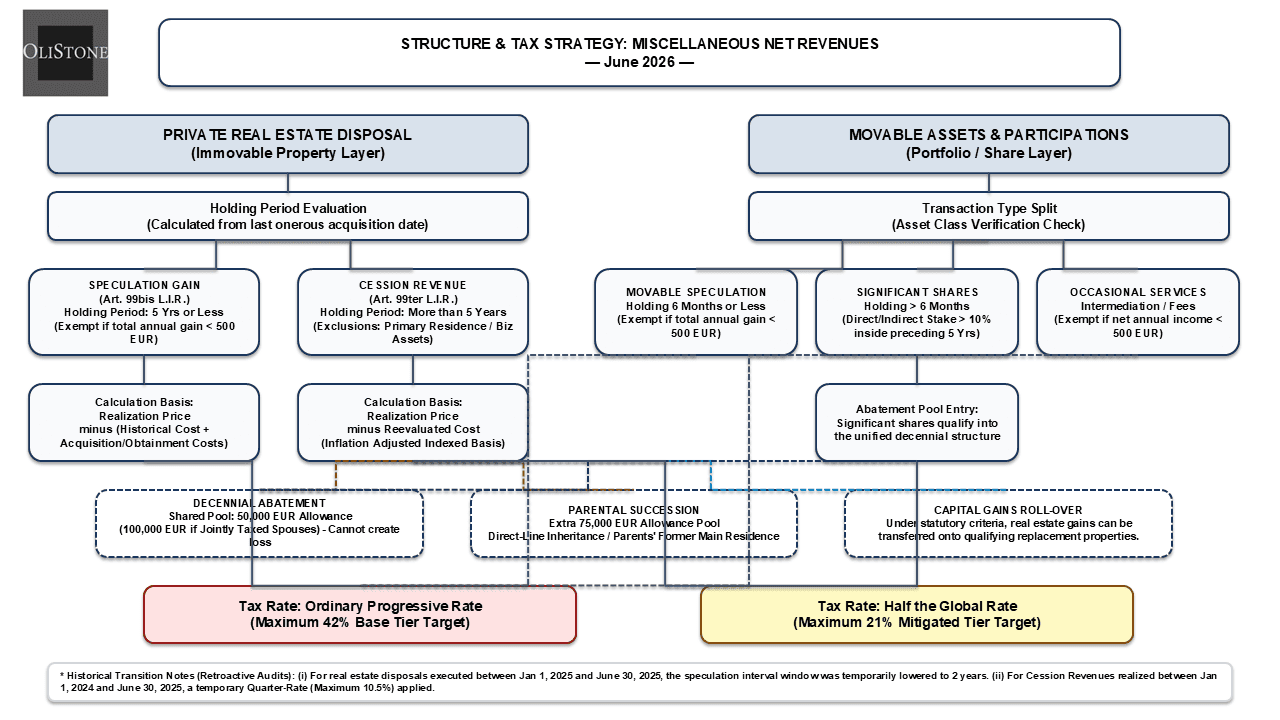
The operational blueprint below illustrates the precise routing, threshold evaluations, and structural deductions mapping private asset disposals to their final fiscal impact.
The Volatility Trap: Speed Over Strategy
During periods of heightened market volatility, investors often react to sharp price movements by shifting allocations, liquidating positions, or rushing real estate exits. While these moves might make sense from a pure liquidity or risk-mitigation standpoint, acting without a tax roadmap turns the state into an unintended primary beneficiary of your portfolio.
Under Luxembourg’s net miscellaneous revenue framework, the tax administration draws an unforgiving line between long-term wealth management and short-term "speculation". If you cross that line due to a rushed decision, the fiscal consequences are severe:
- The Speculation Penalty: Short-term real estate realizations (typically within a statutory 5-year window) are classified under Article 99bis L.I.R. and hit with ordinary progressive tax rates topping out at 42%.
- The Long-Term Reward: Patiently crossing that holding threshold shifts the transaction under Article 99ter L.I.R. (Cession Revenue), dropping the maximum exposure down to a global half-rate of 21%, while unlocking significant decennial deductions and monetary revaluation adjustments.
When tens of millions of euros are on the line, letting market panic dictate your timing means volunteering to pay double the tax rate on your hard-earned gains. It is the classic error of prioritizing short-term portfolio liquidity over structural wealth preservation.
Deconstructing the Immovable Property Layer
As visualized in our strategic architecture framework, private real estate disposals face an immediate binary fork based on the holding period evaluation. This evaluation is measured strictly from the date of the last onerous acquisition (the notary deed) to the date of the subsequent sale deed.
1. The Speculation Zone (Art. 99bis L.I.R.)
If an immovable property is held for 5 years or less, any gain derived from its alienation is treated as a speculation benefit. In this zone, the tax framework assumes a short-term profit-seeking motive. Consequently, the law strips away the structural benefits granted to long-term investors. The capital gain is calculated simply as the realization price minus the historical cost and acquisition-related fees. No adjustments are made for inflation, and no standard decennial abatements can be applied to lower the taxable base. The entire net gain is bundled into the taxpayer's ordinary income and subjected to progressive tax rates up to 42%.
2. The Cession Zone (Art. 99ter L.I.R.)
Once the holding period exceeds 5 years, the fiscal landscape transitions into highly favorable territory. The gain is reclassified as Cession Revenue (Bénéfice de cession). Here, the law recognizes long-term wealth accumulation and introduces two vital defense mechanisms against fiscal drag:
- Monetary Revaluation: The historical purchase price is multiplied by statutory coefficients corresponding to the year of acquisition. This adjusts the cost base upward to account for monetary depreciation, effectively ensuring that you do not pay income tax on artificial gains driven entirely by inflation.
- The Decennial Abatement: Under Article 130, paragraph 4 L.I.R., the capital gain is reduced by a standard allowance of €50,000 per individual (scaled to €100,000 for spouses or partners taxed collectively). This abatement regenerates every 10 years, serving as a powerful cyclical planning tool.
Case Study: The €4.2 Million Mistake
To understand how easily wealth evaporates under poor planning, let us examine a scenario involving the disposal of a privately held residential real estate asset valued at €20,000,000.
Imagine an investor who acquired a prime residential building asset for €10,000,000 (inclusive of historical cost and acquisition fees). A sudden shift in market volatility creates a strategic need for liquidity, prompting the investor to sell the property for €20,000,000.
Here is how a mere difference in timing and structural planning changes the outcome by millions:
Scenario A: Poor Planning & Market Panic
The Speculation TrapDriven by market anxiety, the investor liquidates the asset 4 years and 11 months after acquisition—just weeks shy of the 5-year threshold.
| Tax Classification: | Speculation Gain (Bénéfice de spéculation) |
| The Calculation: | The €10,000,000 net capital gain is taxed as ordinary income without any monetary revaluation or standard decennial abatements. |
| Tax Rate: | Exposed to the maximum ordinary progressive rate of 42%. |
| Tax Bill: | €4,200,000 handed directly to the tax administration. |
Scenario B: Structured Tax Asset Planning
The Cession StrategyThe investor consults a tax asset planner and waits just two additional months, crossing the 5-year holding period milestone.
| Tax Classification: | Cession Revenue (Bénéfice de cession) |
| The Calculation: | Taxable Gain = €20,000,000 (Realization) - €11,000,000 (Revalued Cost) - €50,000 (Abatement) = €8,950,000 |
| Tax Rate: | Taxed at the favorable global half-rate of 21%. |
| Tax Bill: | €1,879,500. |
The Cost of Poor Planning:
€2,320,500By failing to plan around the 5-year statutory clock and neglecting cost-base revaluation, the investor in Scenario A needlessly threw away more than €2.3 million on a single transaction.
The Portfolio & Share Layer: Movable Assets & Participations
As highlighted on the right-hand column of the strategic chart, the fiscal framework applies an entirely different set of rules to the portfolio and share layer. For movable assets and corporate participations, the statutory timeline scales down from years to months, but the tracking requirements remain just as rigid.
1. Movable Speculation vs. Significant Shares
When dealing with non-real estate assets—such as corporate shares, tokenized assets, or unique portfolio holdings—the law establishes a short-term speculation threshold of 6 months or less. Any gain realized within this window is entirely exempt from income tax only if the total annual net gain from such transactions remains under €500. Once you breach that baseline, the entire amount becomes fully taxable at ordinary progressive rates.
However, when an investor holds a Significant Shareholding (Participation importante), a distinct long-term regime takes over. A participation is legally defined as "significant" if the taxpayer, alone or collectively with their spouse and minor children, has directly or indirectly owned more than 10% of the capital of a collective entity at any point during the 5 years preceding the date of disposal.
2. Cross-Layer Abatement Integration
One of the most powerful and underutilized components of structural tax strategy is the integration of the decennial abatement across different asset layers. If a significant shareholding is alienated more than 6 months after its acquisition, the realized capital gain is routed into the exact same €50,000 (or €100,000 for collectively taxed couples) decennial abatement pool shared by long-term real estate cession revenues.
Because this pool is shared, a high-net-worth individual liquidating both corporate shares and private real estate within the same ten-year window faces a structural allocation problem. Without sophisticated cross-layer asset planning, an investor might accidentally consume their abatement on a lower-taxed corporate asset while leaving a heavily exposed real estate gain fully unprotected.
Key Takeaways for High-Net-Worth Asset Protection
- Never Let Volatility Dictate Timeline Blindly: A market dip or spike might tempt you to pull the trigger on a rapid exit, but always calculate the tax cliff first. Missing a statutory deadline by a single day can alter your tax rate by 100% and expose your entire gain to unmitigated progressive taxation.
- Track the True Nature of Inherited Assets: If you are disposing of real estate acquired via direct-line family succession, the law provides highly specific structural reliefs. While the inheritance itself is exempt from income tax, the subsequent sale remains taxable. However, if the property was used by your parents as their principal residence, Article 130, paragraph 5 L.I.R. grants a unique, additional €75,000 allowance to significantly insulate the exit.
- Optimize Combined Abatements: Substantial deductions, like the €50,000 decennial abatement, are shared across both immovable property sessions and significant corporate shareholdings. Sound planning ensures these deductions are mathematically allocated to the asset yielding the highest nominal tax exposure.
- Leverage Roll-Over and Deferral Mechanisms: Under specific legal frameworks, capital gains derived from the sale of buildings can be transferred and rolled over onto qualifying replacement properties, completely deferring immediate tax liability and allowing the capital to continue compounding uninterrupted.
Conclusion
In the world of wealth preservation, alpha isn't just generated by picking the right asset or timing the market bottom; it is protected by defensive structuring. Volatility is an inherent characteristic of markets, but excessive taxation due to poor planning is entirely optional. Don't let your legacy be a multi-million euro cautionary tale.